Non La, also known as the palm-leaf conical hat, holds great significance in Vietnamese culture. It represents the unity of the Vietnamese people, transcending age, sex, and race. This timeless accessory has a fascinating origin story closely tied to the history of agriculture in Vietnam.
Legends and Origins
According to legend, a giant woman descended from the sky to protect humanity during a torrential rainstorm. To shield herself from the deluge, she wore a hat made of four round-shaped leaves. After her heroic act, the Vietnamese people built a temple in her honor, immortalizing her as the Rain-shielding Goddess.
Connecting with Tradition
Inspired by the Goddess’ hat, the Vietnamese began creating their own version using stitched palm leaves. This humble yet versatile hat, now known as Non La, became an essential part of the daily lives of peasants, boatmen, and women working in the fields.

Women in Non la at Dong Ba Market. Photo: @soaipham
Craftsmanship and Artistry
Non La is crafted using simple and readily available materials such as palm leaves, bark from the Moc tree, and bamboo. These hats are widely available, and numerous traditional villages produce high-quality conical hats. One such village is Chuong, located 30km southwest of Hanoi. It has been renowned for its handmade palm-leaf conical hats for centuries. Among the various styles, the ‘Non bai tho’ (poem hat) from Hue stands out, featuring intricate designs and even lyric lines of verse hidden beneath the layers of leaves, revealed only by sunlight.
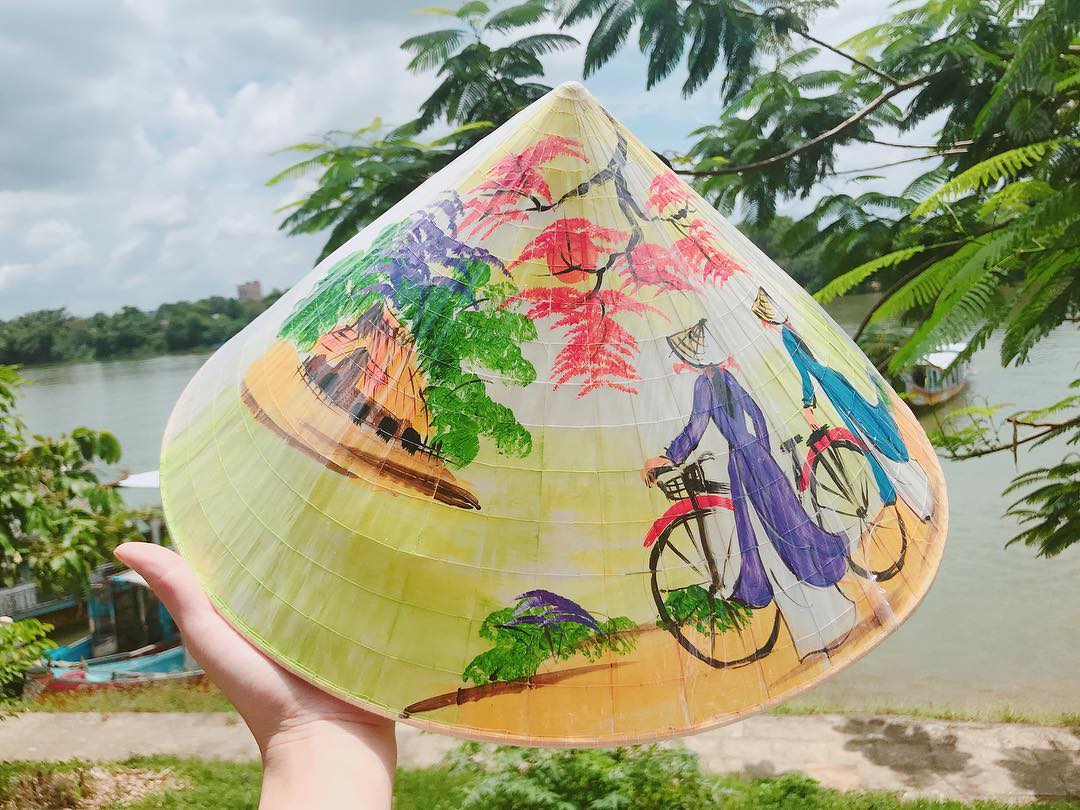
Non bai tho. Photo: @phuongloan2302
Evolution and Diversity
Over the course of thousands of years, Non La has evolved into different variations from its original form. In the past, people classified the hats into three main types: Non muoi (or ‘Non ba tam’, ‘Non quai thao’), medium-sized hats, and head-hats. The Non quai thao, with its flat and round shape measuring about 1 meter in diameter, was especially important for countryside women attending festivities or pagodas, as well as female singers during the Lim festival in Bac Ninh. Head-hats, on the other hand, were the smallest and had the lowest selvage. Additionally, the hats were categorized based on the social status of their owners, with specific designs for the elderly, the affluent, mandarins, children, troops, and monks. Each variety possessed unique shapes and styles, often varying across different regions of Vietnam.
Versatility and Symbolism
Non La serves various practical purposes, such as providing protection from the sun, serving as a basket for women going to the market, and acting as a fan during scorching summer days for ploughmen. Moreover, it holds sentimental value as a cherished keepsake. The image of a young lady wearing Non La and Ao dai, the traditional Vietnamese dress, represents the timeless beauty of Vietnam. As a symbol deeply ingrained in the national spirit, Non La connects Vietnamese people and their rich cultural heritage. Many travelers seek out Non La as a special souvenir to capture the essence of Vietnam.
Experience the charm of Vietnam with its iconic Non La. Explore the enchanting Vietnamese culture and heritage with our Travel Guide. Travel Guide